Introduction
A flash of red among the leaves may be your first glimpse of a Summer Tanager. This migratory songbird spends the nonbreeding season in Costa Rica before returning north to breed. For visitors birdwatching around Katira and Río Celeste, it is a seasonal species to keep an eye out for along wooded edges and in the canopy.
The adult male is striking, but identifying the bird takes more than looking for red feathers. Females are yellowish, young males can show a mixture of colors, and even a brightly colored bird can disappear behind a few leaves.
Quick Facts
| Feature | What to know |
|---|---|
| Scientific name | Piranga rubra |
| Status in Costa Rica | Migratory visitor |
| Seasonal context | Present during migration and the northern winter, rather than year-round |
| Places to look | Forest edges, secondary growth, and gardens with mature trees |
| Identification clues | Red adult male; yellow to olive-yellow female; thick, pale bill |
| Viewing challenge | Foliage and height can make a clear view difficult |
How to identify it
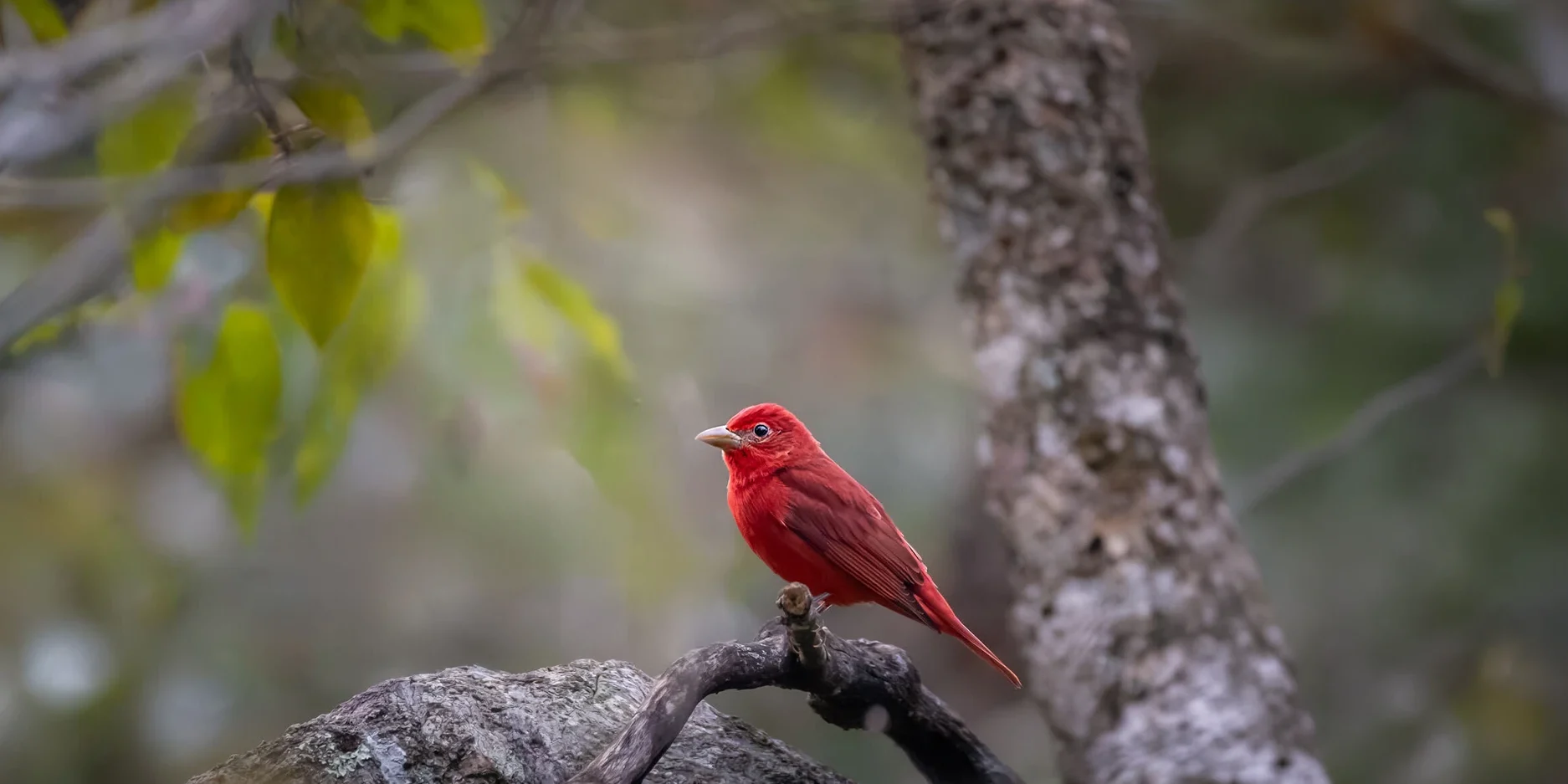
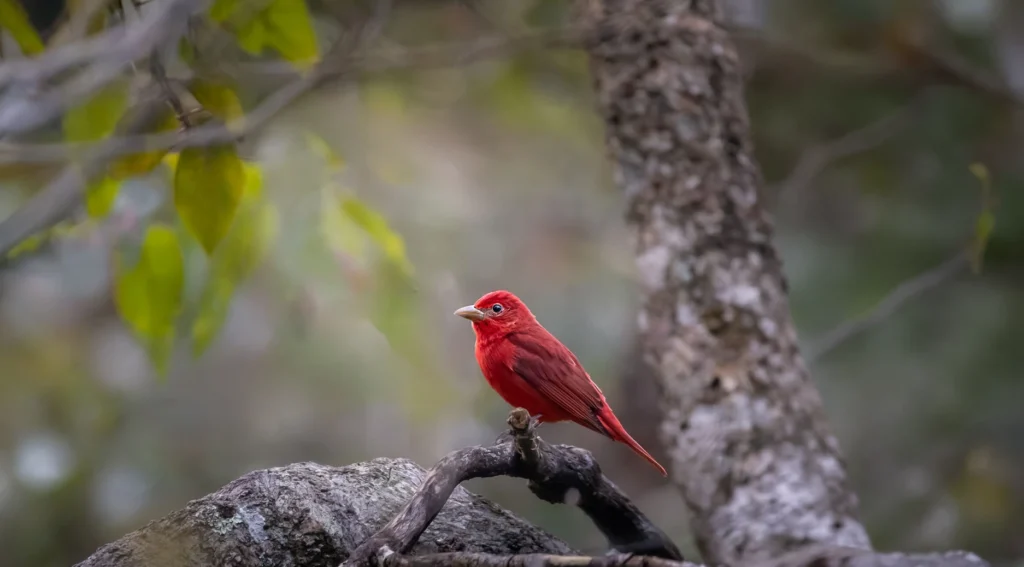
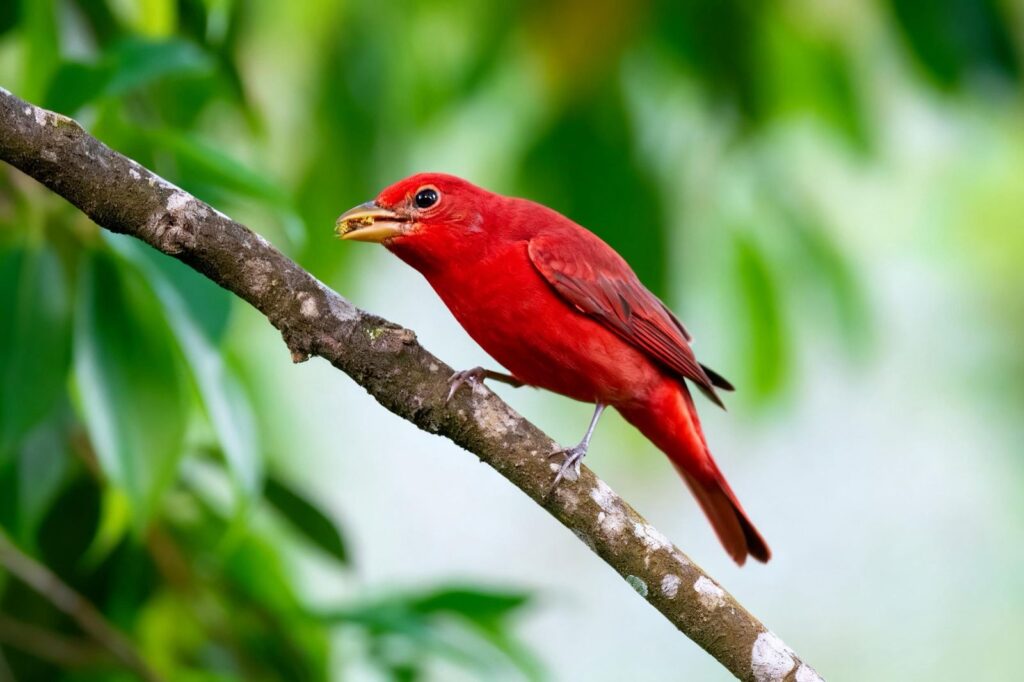
The easiest clue is color, especially if you’re lucky enough to spot an adult male. Male Summer Tanagers are almost entirely bright red, without the dark wings you’ll see on some other red birds. Against the green forest even a quick flash of that color can be enough to get your attention.
Females look completely different. Their plumage ranges from yellow to olive-yellow, sometimes with slightly darker wings. They blend into the canopy much more easily, so take a second look at any yellowish bird moving quietly through the leaves.
Summer Tanagers are medium-sized songbirds, roughly 7–8 inches (17–20 cm) long. One useful feature to notice through binoculars is the bill: it is fairly thick and pale, giving the bird a sturdier profile than you might expect from a tanager.
Young males can make identification a little more interesting. During the transition to their adult plumage, they may show a patchy mix of yellow and red feathers instead of the solid red of a mature male. If you see a bird that seems to be wearing both colors at once, it’s worth taking a closer look.
Best time of the year to see it
Summer Tanagers are migratory visitors to Costa Rica, so timing your visit makes a difference. In Río Celeste they can usually be found from September through April, when they leave their breeding grounds farther north and spend the nonbreeding season in the tropics.
The winter months, especially November through March, are a good window to look for them. By then, migration is largely over and the birds are settled into the habitats they use during their stay in Costa Rica.
If a Summer Tanager is high on your birding list, planning a visit during the northern winter will give you a much better chance of spotting that flash of red in the canopy.
Best time of the day to spot the Summer Tanager
Early morning is your best bet. From sunrise through the first few hours of the day, Summer Tanagers are more likely to be actively moving and feeding, which makes them easier to notice in the trees. This is also when the forest is generally at its liveliest, so listening as you walk can help you pick up a bird before you actually see it.
Late afternoon can offer another good window, particularly when the heat of the day begins to ease and bird activity picks up again. Look for movement along forest edges and in the upper branches where there is still enough light to catch the red plumage of a male.
Weather matters here, too. Río Celeste is a humid, rainy area, and heavy rain can make birding much quieter. A calm morning or a break after the rain is a good moment to get your binoculars back up. Birds often become easier to detect once the forest starts moving again.
But once a year, this secretive bird reveals itself. Agami Herons nest in dramatic rookeries — colonies that can hold hundreds, even a thousand nests in a single stretch of forest. Only a handful of these rookeries are known to exist across the entire region. In 2025, a new one was discovered near Katira de Guatuso, Costa Rica, making it a prime destination for an Agami Island birding trip, and it’s quickly become one of the most accessible places on Earth to witness this extraordinary bird at home in the wild.
At Onca Tours, we’ll take you there.
How to spot a Summer Tanager
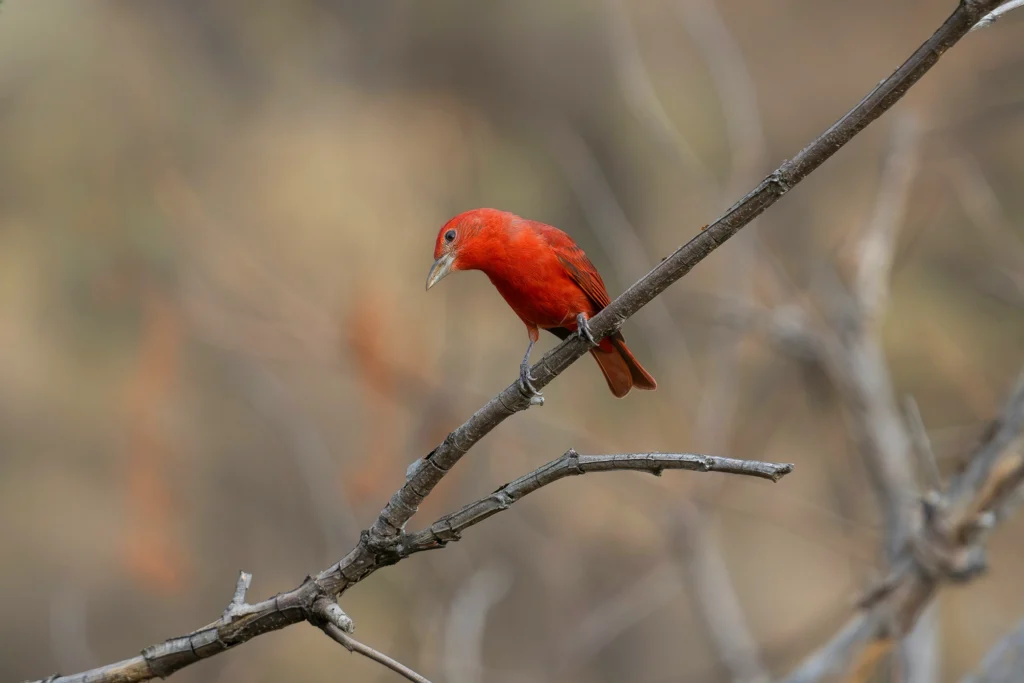
When looking for a Summer Tanager around Río Celeste, keep your eyes on the middle and upper levels of the trees, especially along forest edges and openings in the canopy. Watch for short flights or movement between branches; a flash of red can quickly give away a male, while females are much easier to miss among the green leaves.
Listening can be just as useful as looking. If you hear a call nearby, pause before raising your binoculars and try to narrow down which tree it’s coming from. Once you have the direction, scan that part of the canopy for movement.
And don’t give up on a tree too quickly. Thick foliage can hide a bird that’s surprisingly close, so a moving branch, another call, or one quick flight may be all you need to finally spot it.
Listen Before You Look
Both sexes give a dry, clicking call often written as pit-ti-tuck. Learning that sound can help you locate a bird before you see it. The male’s song consists of short phrases of slurred whistles, sometimes compared to an American Robin’s.
If you hear a call overhead, stop and work out its direction before raising your binoculars. Focus on one part of the tree and watch for movement instead of repeatedly scanning the whole canopy.
You can listen to reference recordings in the Cornell Lab’s sound guide before your walk.
Local Birding Tip
When you reach a clearing or a more open stretch of trail, don’t walk straight through it. Stop near the forest edge and scan the tallest trees from a little farther back. That wider view makes it easier to catch a Summer Tanager moving between treetops or landing on an exposed branch.
Take your time with fruiting trees, too. Even if you don’t spot a red male right away, watch for movement among the leaves. Females are much easier to overlook, and sometimes the first clue is simply a yellow-green bird moving quietly through the canopy.
Why Birdwatchers Want to See It
An adult male Summer Tanager is hard to forget. Its almost entirely red plumage stands out beautifully against the green canopy, especially when the bird moves onto an open branch. Females are less flashy, but finding one among the leaves can be just as satisfying.
There’s also the fact that Summer Tanagers are only here for part of the year. They spend the nonbreeding season in Costa Rica before eventually heading north again, so seeing one around Río Celeste is a seasonal experience rather than something you can count on year-round.
And despite that bright red plumage, males can be surprisingly easy to miss. They often stay high in the trees, where leaves and branches quickly hide them from view. Finally getting a clear look after watching the canopy for movement is part of what makes the sighting so rewarding.
Photography Tips
For bird photographers, a 300–500 mm lens is a good starting point around Río Celeste, with 500–600 mm giving you extra reach when Summer Tanagers stay high in the canopy. A wide aperture, Auto ISO, and a shutter speed around 1/1000s or faster can help with birds moving between branches. Continuous autofocus with bird/eye detection is also useful, while a smaller AF area can help when leaves get in the way.
Light under the canopy can change quickly from deep shade to bright openings. Watch your highlights when photographing a red male against a dark background, and be ready to adjust exposure as the bird moves. If you find one feeding, stay with it for a while. It may move or make a short flight after an insect, giving you a much better shot.
For phones or smaller cameras, avoid pushing the digital zoom too far. Wait for an open perch and let the surrounding forest become part of the photo. Whatever you’re carrying, keep it protected from sudden rain and humidity—both are part of photographing birds around Río Celeste.
Interesting Behavior & Fun Facts
One of the most interesting things about a Summer Tanager is how it handles bees and wasps. It can catch them in midair, return to a perch, and beat the insect against the branch. With bees, it may even rub the prey against the perch to remove the stinger before swallowing it.
If you see one making short flights from the canopy and returning to the same perch around Río Celeste, give it a closer look it may be hunting. Summer Tanagers also eat fruit, but watching one deal with a stinging insect is a much more memorable glimpse into how well adapted this bird is to its food.
Other Birds You May See Nearby
Looking for a Summer Tanager often means keeping an eye on the same forest edges and treetops used by many other birds in Río Celeste. Scarlet-rumped Tanagers are another colorful possibility, while White-collared Manakins are worth watching and listening for closer to the forest understory.
Higher in the trees, you may also come across Keel-billed Toucans or Collared Aracaris, especially around fruiting trees. Toucans are often heard before they come into view, so don’t be surprised if a call overhead leads you to a completely different bird than the one you were originally looking for.
For a wider look at the species recorded by local guides, explore our Birds in Río Celeste guide, or read our guide to toucans in Costa Rica to learn which species can be found nearby Río Celeste and Tenorio.
FAQs About Summer Tanagers in Río Celeste
Is the Summer Tanager found in Costa Rica?
Yes. The Summer Tanager is a migratory visitor to Costa Rica. It spends part of the year in the tropics before returning north for the breeding season.
Can you see a Summer Tanager near Río Celeste?
Yes. Summer Tanagers can be found in Río Celeste and Bijagua during their time in Costa Rica. Forest edges, secondary growth, gardens, and open areas with mature trees are all worth checking, especially where you have a clear view of the canopy.
When is the best time to see a Summer Tanager in Costa Rica?
The best chances are generally from September through April, with November through March being a particularly good window. By late spring, most Summer Tanagers are heading north again toward their breeding grounds.
Is the Summer Tanager resident or migratory in Costa Rica?
It is migratory. Summer Tanagers breed farther north and travel south for the nonbreeding season, which is why seeing one in Río Celeste depends on the time of year.
Where should I look for a Summer Tanager around Río Celeste?
Start with the middle and upper parts of the trees, particularly along forest edges and clearings. Don’t overlook tall trees around gardens and more open areas near Bijagua either. Listening for a call before scanning the canopy can make the search much easier.
Is a Summer Tanager difficult to spot?
It can be. The bright red male may sound easy to find, but thick tropical foliage can hide even a very colorful bird. Females are trickier because their yellow-green plumage blends into the leaves. A little patience and knowing where to look goes a long way.